
自定义同意授权页面
TIP
自定义授权服务器同意授权页面页面扩展
效果图
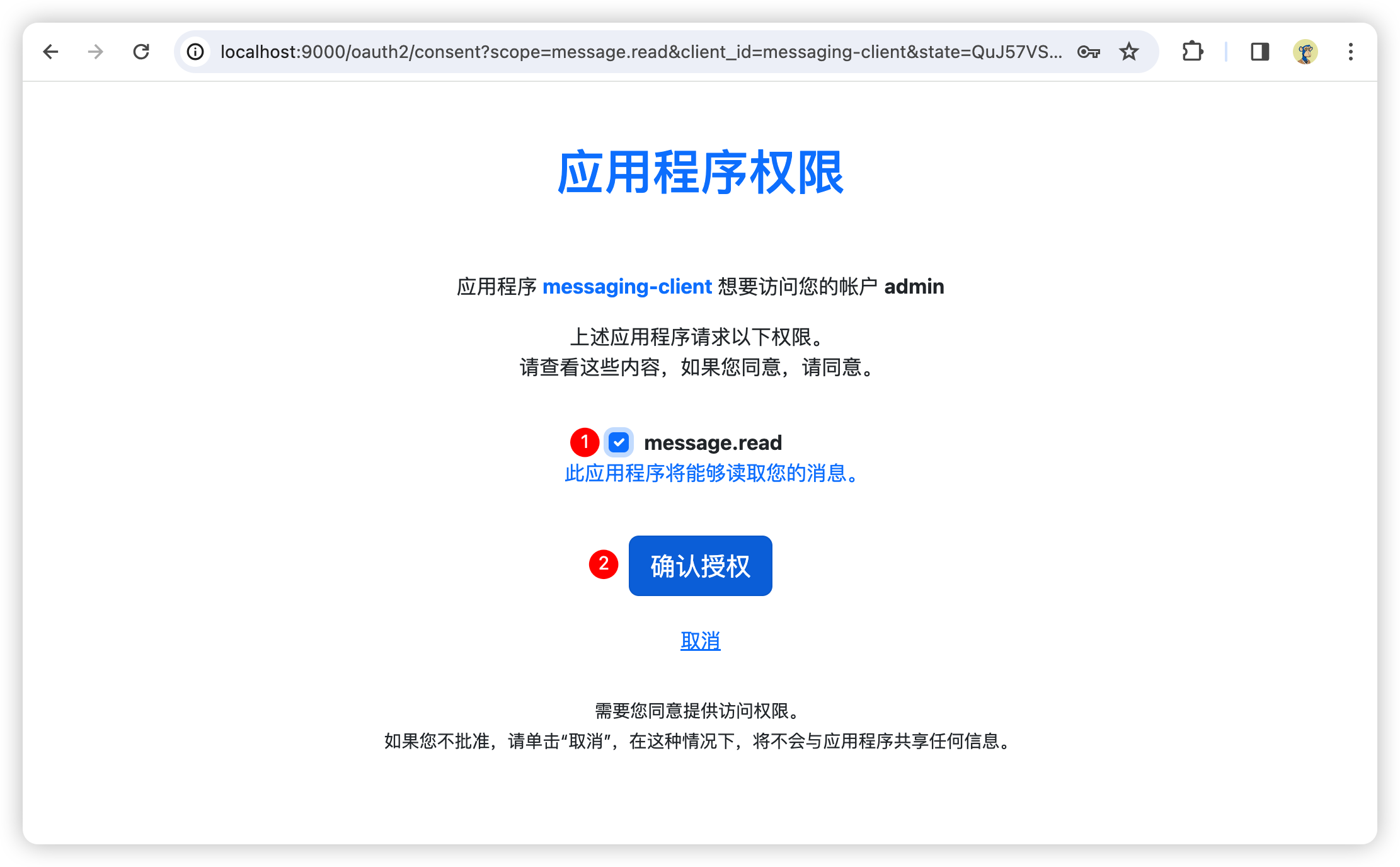
consent.html
文件目录:src\main\resources\templates\consent.html
html
<!--
  ~    Copyright [yyyy] [name of copyright owner]
  ~
  ~    Licensed under the Apache License, Version 2.0 (the "License");
  ~    you may not use this file except in compliance with the License.
  ~    You may obtain a copy of the License at
  ~
  ~        http://www.apache.org/licenses/LICENSE-2.0
  ~
  ~    Unless required by applicable law or agreed to in writing, software
  ~    distributed under the License is distributed on an "AS IS" BASIS,
  ~    WITHOUT WARRANTIES OR CONDITIONS OF ANY KIND, either express or implied.
  ~    See the License for the specific language governing permissions and
  ~    limitations under the License.
  -->

<!DOCTYPE html>
<html lang="zh" xmlns="http://www.w3.org/1999/xhtml" xmlns:th="https://www.thymeleaf.org">
<head>
  <meta charset="utf-8" />
  <meta name="viewport" content="width=device-width, initial-scale=1">
  <title>需要同意 | PIGX 微服务开发平台</title>
  <link rel="stylesheet" href="/webjars/bootstrap/css/bootstrap.css" th:href="@{/webjars/bootstrap/css/bootstrap.css}" />
  <script>
    function cancelConsent() {
      document.consent_form.reset();
      document.consent_form.submit();
    }
  </script>
</head>
<body>
<div class="container">
  <div class="row py-5">
    <h1 class="text-center text-primary">应用程序权限</h1>
  </div>
  <div class="row">
    <div class="col text-center">
      <p>
        应用程序
        <span class="fw-bold text-primary" th:text="${clientId}"></span>
        想要访问您的帐户
        <span class="fw-bold" th:text="${principalName}"></span>
      </p>
    </div>
  </div>
  <div th:if="${userCode}" class="row">
    <div class="col text-center">
      <p class="alert alert-warning">
        You have provided the code
        <span class="fw-bold" th:text="${userCode}"></span>.
        验证此代码是否与设备上显示的内容相匹配。
      </p>
    </div>
  </div>
  <div class="row pb-3">
    <div class="col text-center">
      <p>
        上述应用程序请求以下权限。<br/>
        请查看这些内容,如果您同意,请同意。
      </p>
    </div>
  </div>
  <div class="row">
    <div class="col text-center">
      <form name="consent_form" method="post" th:action="${requestURI}">
        <input type="hidden" name="client_id" th:value="${clientId}">
        <input type="hidden" name="state" th:value="${state}">
        <input th:if="${userCode}" type="hidden" name="user_code" th:value="${userCode}">

        <div th:each="scope: ${scopes}" class="form-check py-1">
          <input class="form-check-input"
                 style="float: none"
                 type="checkbox"
                 name="scope"
                 th:value="${scope.scope}"
                 th:id="${scope.scope}">
          <label class="form-check-label fw-bold px-2" th:for="${scope.scope}" th:text="${scope.scope}"></label>
          <p class="text-primary" th:text="${scope.description}"></p>
        </div>

        <p th:if="${not #lists.isEmpty(previouslyApprovedScopes)}">
          您已向上述应用程序授予以下权限:
        </p>
        <div th:each="scope: ${previouslyApprovedScopes}" class="form-check py-1">
          <input class="form-check-input"
                 style="float: none"
                 type="checkbox"
                 th:id="${scope.scope}"
                 disabled
                 checked>
          <label class="form-check-label fw-bold px-2" th:for="${scope.scope}" th:text="${scope.scope}"></label>
          <p class="text-primary" th:text="${scope.description}"></p>
        </div>

        <div class="pt-3">
          <button class="btn btn-primary btn-lg" type="submit" id="submit-consent">
            确认授权
          </button>
        </div>
        <div class="pt-3">
          <button class="btn btn-link regular" type="button" id="cancel-consent" onclick="cancelConsent();">
            取消
          </button>
        </div>
      </form>
    </div>
  </div>
  <div class="row pt-4">
    <div class="col text-center">
      <p>
        <small>
          需要您同意提供访问权限。<br/>
          如果您不批准,请单击“取消”,在这种情况下,将不会与应用程序共享任何信息。
        </small>
      </p>
    </div>
  </div>
</div>
</body>
</html>
AuthorizationConsentController.java
java
/*
 *    Copyright [yyyy] [name of copyright owner]
 *
 *    Licensed under the Apache License, Version 2.0 (the "License");
 *    you may not use this file except in compliance with the License.
 *    You may obtain a copy of the License at
 *
 *        http://www.apache.org/licenses/LICENSE-2.0
 *
 *    Unless required by applicable law or agreed to in writing, software
 *    distributed under the License is distributed on an "AS IS" BASIS,
 *    WITHOUT WARRANTIES OR CONDITIONS OF ANY KIND, either express or implied.
 *    See the License for the specific language governing permissions and
 *    limitations under the License.
 */

package com.pigcloud.pigx.auth.web;

import org.springframework.security.oauth2.core.endpoint.OAuth2ParameterNames;
import org.springframework.security.oauth2.core.oidc.OidcScopes;
import org.springframework.security.oauth2.server.authorization.OAuth2AuthorizationConsent;
import org.springframework.security.oauth2.server.authorization.OAuth2AuthorizationConsentService;
import org.springframework.security.oauth2.server.authorization.client.RegisteredClient;
import org.springframework.security.oauth2.server.authorization.client.RegisteredClientRepository;
import org.springframework.stereotype.Controller;
import org.springframework.ui.Model;
import org.springframework.util.StringUtils;
import org.springframework.web.bind.annotation.GetMapping;
import org.springframework.web.bind.annotation.RequestParam;

import java.security.Principal;
import java.util.*;

/**
 * 认证服务器相关自定接口
 *
 * @author Daniel Garnier-Moiroux
 */
@Controller
public class AuthorizationConsentController {

    /**
     * 客户端repository
     */
    private final RegisteredClientRepository registeredClientRepository;

    /**
     * 授权确认管理服务
     */
    private final OAuth2AuthorizationConsentService authorizationConsentService;

    /**
     * 参数注入
     *
     * @param registeredClientRepository  registeredClientRepository
     * @param authorizationConsentService authorizationConsentService
     */
    public AuthorizationConsentController(RegisteredClientRepository registeredClientRepository,
                                          OAuth2AuthorizationConsentService authorizationConsentService) {
        this.registeredClientRepository = registeredClientRepository;
        this.authorizationConsentService = authorizationConsentService;
    }

    /**
     * 自定义确认授权页面
     *
     * @param principal principal
     * @param model     model
     * @param clientId  clientId
     * @param scope     scope
     * @param state     state
     * @param userCode  userCode
     * @return String
     */
    @GetMapping(value = "/oauth2/consent")
    public String consent(Principal principal, Model model,
                          @RequestParam(OAuth2ParameterNames.CLIENT_ID) String clientId,
                          @RequestParam(OAuth2ParameterNames.SCOPE) String scope,
                          @RequestParam(OAuth2ParameterNames.STATE) String state,
                          @RequestParam(name = OAuth2ParameterNames.USER_CODE, required = false) String userCode) {

        // Remove scopes that were already approved
        Set<String> scopesToApprove = new HashSet<>();
        Set<String> previouslyApprovedScopes = new HashSet<>();
        RegisteredClient registeredClient = this.registeredClientRepository.findByClientId(clientId);
        OAuth2AuthorizationConsent currentAuthorizationConsent =
                this.authorizationConsentService.findById(registeredClient.getId(), principal.getName());
        Set<String> authorizedScopes;
        if (currentAuthorizationConsent != null) {
            authorizedScopes = currentAuthorizationConsent.getScopes();
        } else {
            authorizedScopes = Collections.emptySet();
        }
        for (String requestedScope : StringUtils.delimitedListToStringArray(scope, " ")) {
            if (OidcScopes.OPENID.equals(requestedScope)) {
                continue;
            }
            if (authorizedScopes.contains(requestedScope)) {
                previouslyApprovedScopes.add(requestedScope);
            } else {
                scopesToApprove.add(requestedScope);
            }
        }

        model.addAttribute("clientId", clientId);
        model.addAttribute("clientName", registeredClient.getClientName());
        model.addAttribute("state", state);
        model.addAttribute("scopes", withDescription(scopesToApprove));
        model.addAttribute("previouslyApprovedScopes", withDescription(previouslyApprovedScopes));
        model.addAttribute("principalName", principal.getName());
        model.addAttribute("userCode", userCode);
        if (StringUtils.hasText(userCode)) {
            model.addAttribute("requestURI", "/oauth2/device_verification");
        } else {
            model.addAttribute("requestURI", "/oauth2/authorize");
        }

        return "consent";
    }

    private static Set<ScopeWithDescription> withDescription(Set<String> scopes) {
        Set<ScopeWithDescription> scopeWithDescriptions = new HashSet<>();
        for (String scope : scopes) {
            scopeWithDescriptions.add(new ScopeWithDescription(scope));

        }
        return scopeWithDescriptions;
    }

    /**
     * 作用域权限描述
     */
    public static class ScopeWithDescription {
        /**
         * DEFAULT_DESCRIPTION
         */
        private static final String DEFAULT_DESCRIPTION = "UNKNOWN SCOPE - 我们无法提供有关此权限的信息,请在授予此权限时小心。";
        /**
         * scopeDescriptions
         */
        private static final Map<String, String> scopeDescriptions = new HashMap<>();

        static {
            scopeDescriptions.put(
                    OidcScopes.PROFILE,
                    "此应用程序将能够读取您的个人资料信息。"
            );
            scopeDescriptions.put(
                    "message.read",
                    "此应用程序将能够读取您的消息。"
            );
            scopeDescriptions.put(
                    "message.write",
                    "此应用程序将能够添加新消息。它还可以编辑和删除现有消息。"
            );
            scopeDescriptions.put(
                    "other.scope",
                    "这是范围描述的另一个范围示例。"
            );
        }

        /**
         * scope
         */
        public final String scope;
        /**
         * description
         */
        public final String description;

        ScopeWithDescription(String scope) {
            this.scope = scope;
            this.description = scopeDescriptions.getOrDefault(scope, DEFAULT_DESCRIPTION);
        }
    }
}
AuthorizationServerConfig.java
java
/*
 *    Copyright [yyyy] [name of copyright owner]
 *
 *    Licensed under the Apache License, Version 2.0 (the "License");
 *    you may not use this file except in compliance with the License.
 *    You may obtain a copy of the License at
 *
 *        http://www.apache.org/licenses/LICENSE-2.0
 *
 *    Unless required by applicable law or agreed to in writing, software
 *    distributed under the License is distributed on an "AS IS" BASIS,
 *    WITHOUT WARRANTIES OR CONDITIONS OF ANY KIND, either express or implied.
 *    See the License for the specific language governing permissions and
 *    limitations under the License.
 */

package com.pigcloud.pigx.auth.config;

import com.nimbusds.jose.jwk.JWKSet;
import com.nimbusds.jose.jwk.RSAKey;
import com.nimbusds.jose.jwk.source.ImmutableJWKSet;
import com.nimbusds.jose.jwk.source.JWKSource;
import com.nimbusds.jose.proc.SecurityContext;
import org.springframework.context.annotation.Bean;
import org.springframework.context.annotation.Configuration;
import org.springframework.core.Ordered;
import org.springframework.core.annotation.Order;
import org.springframework.http.MediaType;
import org.springframework.security.config.Customizer;
import org.springframework.security.config.annotation.web.builders.HttpSecurity;
import org.springframework.security.core.userdetails.User;
import org.springframework.security.core.userdetails.UserDetails;
import org.springframework.security.core.userdetails.UserDetailsService;
import org.springframework.security.oauth2.core.AuthorizationGrantType;
import org.springframework.security.oauth2.core.ClientAuthenticationMethod;
import org.springframework.security.oauth2.core.oidc.OidcScopes;
import org.springframework.security.oauth2.jwt.JwtDecoder;
import org.springframework.security.oauth2.server.authorization.InMemoryOAuth2AuthorizationConsentService;
import org.springframework.security.oauth2.server.authorization.OAuth2AuthorizationConsentService;
import org.springframework.security.oauth2.server.authorization.client.InMemoryRegisteredClientRepository;
import org.springframework.security.oauth2.server.authorization.client.RegisteredClient;
import org.springframework.security.oauth2.server.authorization.client.RegisteredClientRepository;
import org.springframework.security.oauth2.server.authorization.config.annotation.web.configuration.OAuth2AuthorizationServerConfiguration;
import org.springframework.security.oauth2.server.authorization.config.annotation.web.configurers.OAuth2AuthorizationServerConfigurer;
import org.springframework.security.oauth2.server.authorization.settings.AuthorizationServerSettings;
import org.springframework.security.oauth2.server.authorization.settings.ClientSettings;
import org.springframework.security.provisioning.InMemoryUserDetailsManager;
import org.springframework.security.web.SecurityFilterChain;
import org.springframework.security.web.authentication.LoginUrlAuthenticationEntryPoint;
import org.springframework.security.web.util.matcher.MediaTypeRequestMatcher;

import java.security.KeyPair;
import java.security.KeyPairGenerator;
import java.security.interfaces.RSAPrivateKey;
import java.security.interfaces.RSAPublicKey;
import java.util.UUID;

/**
 * 授权服务器配置
 *
 * @author heyuq
 */
@Configuration(proxyBeanMethods = false)
public class AuthorizationServerConfig {

    /**
     * 自定义同意授权页面。
     */
    private static final String CUSTOM_CONSENT_PAGE_URI = "/oauth2/consent";

    /**
     * 授权服务器端点配置
     *
     * @param http spring security核心配置类
     * @return 过滤器链
     * @throws Exception 抛出
     */
    @Bean
    @Order(Ordered.HIGHEST_PRECEDENCE)
    public SecurityFilterChain authorizationServerSecurityFilterChain(HttpSecurity http)
            throws Exception {

        // 应用OAuth2授权服务器的默认安全配置。
        OAuth2AuthorizationServerConfiguration.applyDefaultSecurity(http);

        // 配置OAuth2授权服务器的安全过滤链,启用OpenID Connect 1.0。
        // OpenID Connect是OAuth 2.0的一个扩展,用于添加用户身份验证。
        http.getConfigurer(OAuth2AuthorizationServerConfigurer.class)
                // 设置自定义用户确认授权页
                .authorizationEndpoint(authorizationEndpoint -> authorizationEndpoint
                        .consentPage(CUSTOM_CONSENT_PAGE_URI)
                )
                .oidc(Customizer.withDefaults());

        // @formatter:off
        http
            // 配置异常处理,当从授权端点未认证时,重定向到登录页面。
            // 这里定义了一个登录URL认证入口点,并指定它只适用于TEXT_HTML媒体类型。
            .exceptionHandling((exceptions) -> exceptions
                .defaultAuthenticationEntryPointFor(
                    new LoginUrlAuthenticationEntryPoint("/login"),
                    new MediaTypeRequestMatcher(MediaType.TEXT_HTML)
                )
            )
            // 配置OAuth2资源服务器,接受用户信息和/或客户端注册的访问令牌。
            // 这里使用JWT(JSON Web Tokens)作为访问令牌的格式。
            .oauth2ResourceServer((resourceServer) -> resourceServer
                .jwt(Customizer.withDefaults()));
        // @formatter:on

        // 构建并返回配置好的SecurityFilterChain对象。
        return http.build();
    }

    /**
     * 默认安全过滤器配置
     *
     * @param http spring security核心配置类
     * @return 过滤器链
     * @throws Exception 抛出
     */
    @Bean
    @Order(2)
    public SecurityFilterChain defaultSecurityFilterChain(HttpSecurity http)
            throws Exception {

        // @formatter:off
        http
            // 配置默认的HTTP请求授权规则,要求所有请求都必须经过身份验证。
            .authorizeHttpRequests((authorize) -> authorize
                // 放行静态资源
                .requestMatchers("favicon.svg", "/assets/**", "/webjars/**", "/error", "/login").permitAll()
                .anyRequest().authenticated()
            )
            // 配置表单登录,使用默认设置。
            // 这处理从授权服务器过滤链重定向到登录页面的情况。
            // .formLogin(Customizer.withDefaults())
            .formLogin(formLogin ->
                formLogin
                    .loginPage("/login")
            );
        // @formatter:on

        return http.build();
    }

    /**
     * UserDetailsService是Spring Security中的一个接口,用于加载用户特定的数据。
     *
     * @return UserDetailsService
     */
    @Bean
    public UserDetailsService userDetailsService() {

        // 创建一个具有默认密码编码器的用户详情对象。
        // 这里定义了一个用户名为"user",密码为"password",角色为"USER"的用户。
        UserDetails userDetails = User.withDefaultPasswordEncoder()
                .username("user")
                .password("password")
                .roles("USER")
                .build();

        // 返回一个基于内存的用户详情服务,它仅包含上面定义的用户。
        return new InMemoryUserDetailsManager(userDetails);
    }

    /**
     * 注册一个 OAuth 2.0客户端
     *
     * @return RegisteredClientRepository实例
     */
    @Bean
    public RegisteredClientRepository registeredClientRepository() {
        // 创建一个RegisteredClient对象,并设置其属性。
        // 使用UUID生成一个唯一的客户端ID。
        RegisteredClient registeredClient = RegisteredClient.withId(UUID.randomUUID().toString())
                // 设置客户端ID为"messaging-client"。
                .clientId("messaging-client")
                // 设置客户端秘密为"{noop}secret",这里的"{noop}"表示不加密。
                .clientSecret("{noop}secret")
                // 设置客户端认证方法为基于客户端秘密的基本认证。
                .clientAuthenticationMethod(ClientAuthenticationMethod.CLIENT_SECRET_BASIC)
                // 设置授权类型为授权码。
                .authorizationGrantType(AuthorizationGrantType.AUTHORIZATION_CODE)
                // 添加刷新令牌授权类型。
                .authorizationGrantType(AuthorizationGrantType.REFRESH_TOKEN)
                // 添加客户端凭证授权类型。
                .authorizationGrantType(AuthorizationGrantType.CLIENT_CREDENTIALS)
                // 设置授权码流程的重定向URI。
                .redirectUri("http://127.0.0.1:8080/login/oauth2/code/messaging-client-oidc")
                // 设置另一个重定向URI,可能用于其他授权流程。
                .redirectUri("http://127.0.0.1:8080/authorized")
                // 设置用户注销后的重定向URI。
                .postLogoutRedirectUri("http://127.0.0.1:8080/logged-out")
                // 添加OpenID范围。
                .scope(OidcScopes.OPENID)
                // 添加Profile范围。
                .scope(OidcScopes.PROFILE)
                // 添加自定义范围"message.read"。
                .scope("message.read")
                // 添加自定义范围"message.write"。
                .scope("message.write")
                // 设置客户端设置,要求每次都需要用户授权同意。
                .clientSettings(ClientSettings.builder().requireAuthorizationConsent(true).build())
                .build(); // 构建RegisteredClient对象。

        // 使用上面创建的RegisteredClient对象,创建一个新的InMemoryRegisteredClientRepository实例,并返回它。
        // InMemoryRegisteredClientRepository是一个简单的内存中的存储库,用于存储和检索RegisteredClient对象。
        return new InMemoryRegisteredClientRepository(registeredClient);
    }

    /**
     * 存储新授权同意和查询现有授权同意的核心组件。它主要由实现 OAuth2 授权请求流(例如 authorization_code 授权)的组件使用
     *
     * @return JdbcOAuth2AuthorizationConsentService
     */
    @Bean
    public OAuth2AuthorizationConsentService authorizationConsentService() {
        // Will be used by the ConsentController
        return new InMemoryOAuth2AuthorizationConsentService();
    }

    /**
     * 配置jwk源,使用非对称加密,公开用于检索匹配指定选择器的JWK的方法
     *
     * @return JWKSource
     */
    @Bean
    public JWKSource<SecurityContext> jwkSource() {
        // 生成RSA密钥对。
        KeyPair keyPair = generateRsaKey();

        // 从密钥对中获取公钥。
        RSAPublicKey publicKey = (RSAPublicKey) keyPair.getPublic();

        // 从密钥对中获取私钥。
        RSAPrivateKey privateKey = (RSAPrivateKey) keyPair.getPrivate();

        // 使用公钥和私钥创建一个RSAKey对象,并为其分配一个随机的UUID作为keyID。
        RSAKey rsaKey = new RSAKey.Builder(publicKey)
                .privateKey(privateKey)
                .keyID(UUID.randomUUID().toString())
                .build();

        // 创建一个包含这个RSAKey的JWKSet对象。
        JWKSet jwkSet = new JWKSet(rsaKey);

        // 返回一个不可变的JWKSet对象,这通常是为了保证安全而设计的。
        return new ImmutableJWKSet<>(jwkSet);
    }

    /**
     * 私有方法,用于生成RSA密钥对。
     *
     * @return KeyPair
     */
    private static KeyPair generateRsaKey() {
        KeyPair keyPair;
        try {
            // 实例化一个RSA密钥对生成器。
            KeyPairGenerator keyPairGenerator = KeyPairGenerator.getInstance("RSA");

            // 初始化密钥对生成器,指定密钥长度为2048位。
            keyPairGenerator.initialize(2048);

            // 生成RSA密钥对。
            keyPair = keyPairGenerator.generateKeyPair();
        } catch (Exception ex) {
            // 如果发生异常,则抛出IllegalStateException。
            throw new IllegalStateException(ex);
        }
        // 返回生成的密钥对。
        return keyPair;
    }

    /**
     * 用于解码签名访问令牌的 JwtDecoder 实例。
     *
     * @param jwkSource jwk源
     * @return JwtDecoder
     */
    @Bean
    public JwtDecoder jwtDecoder(JWKSource<SecurityContext> jwkSource) {
        // 使用OAuth2AuthorizationServerConfiguration类中的静态方法jwtDecoder,
        // 根据提供的JWKSource对象创建JwtDecoder。
        // JwtDecoder是用于解码JWT的组件。
        return OAuth2AuthorizationServerConfiguration.jwtDecoder(jwkSource);
    }

    /**
     * 配置OAuth 2.0授权服务器。
     *
     * @return AuthorizationServerSettings
     */
    @Bean
    public AuthorizationServerSettings authorizationServerSettings() {
        // 创建一个AuthorizationServerSettings对象,并使用默认设置。
        // 这个对象通常用于配置授权服务器的各种设置。
        return AuthorizationServerSettings.builder().build();
    }

}